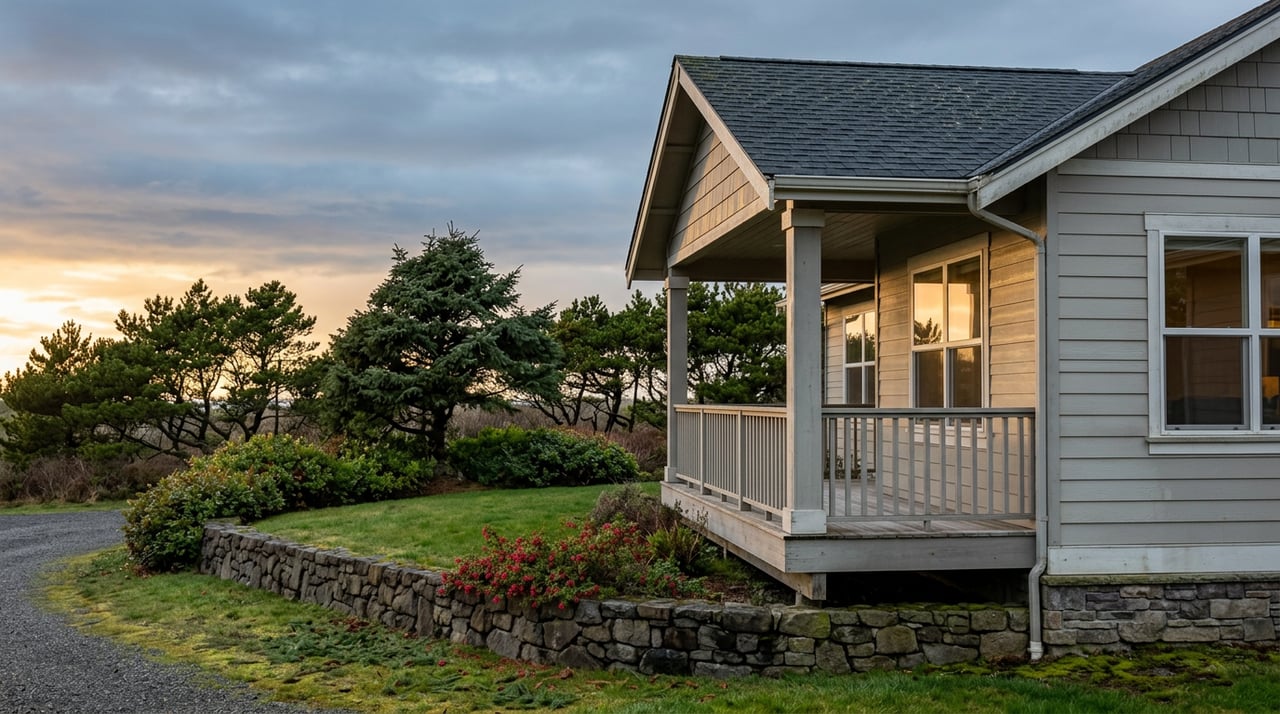
John and Renee Laude own a 1.08-acre property at 7907 Highway 101 North, just north of Yachats, with a bluff that has been collapsing in pieces for years. Their engineering firm, H.G. Schlicker & Associates, documented the damage in detail: a near-vertical bluff face, stripped of vegetation, undercut by wave action, with slump failures that had become more frequent over roughly two decades. Their proposed fix was a 150-foot riprap revetment, built to a height of 26 to 30 feet and roughly 2,010 cubic yards of armor stone and backfill, designed by a certified engineering geologist to state standards.
The Oregon Parks and Recreation Department, which permits any alteration to the ocean shore under state law, said no.
Not because the erosion wasn't real. The department's own decision acknowledged the bluff was failing and that a revetment would likely increase safety for the home behind it. What it could not do was find that the project met the full test the law requires. In its written findings, OPRD stated plainly that it was unable to determine that the standard was met, pointing specifically to the loss of 38 feet of public beach width along the 150-foot structure and the risk of what engineers call end effects, where hardening one stretch of bluff accelerates erosion on the unprotected stretches next to it.
If you're evaluating a bluff-top lot or home in Yachats, this case matters more than any listing description that mentions erosion in passing. The assumption baked into a lot of buyer thinking, that a bad bluff can always be armored later if it gets worse, does not hold up against what actually happened here in 2025.
What OPRD Actually Weighs
The application for 7907 Highway 101 North went to a public hearing in January 2025 after the department received more than ten requests for one during the public comment period. That volume of interest is itself a signal. Ocean shore alteration permits in Lincoln County routinely draw scrutiny from state parks staff, from the Oregon Parks and Recreation Commission, and from advocacy groups tracking cumulative impacts on public beach access.
A separate commission document from April 2025 laid out the general grounds OPRD cites when it turns these applications down: insufficient justification and need, failure to show the design is the least-impact alternative available, and likely harm to public access or the Oregon Coast Trail. The Laude decision touched more than one of these.
Around the same time, Oregon Surfrider's Newport chapter reported a second denial nearby, on a five-acre parcel at Tillicum Beach between Waldport and Yachats. The reasoning there was different but related. The applicant hadn't adequately analyzed alternatives to armoring, including relocating the home elsewhere on the five-acre lot, despite arguing that relocation would be too costly. OPRD's decision noted the application never actually included a cost estimate to support that claim.
Two denials, two different properties, two different technical shortcomings, both inside a few months of each other along the same stretch of coast. That's not an isolated ruling. It's a pattern worth knowing before you write an offer.
What Buyers Tend to Assume, and What the Record Shows
| The common assumption | What the 2025 record actually shows |
|---|---|
| A documented erosion threat is enough to get a permit | OPRD can find the erosion real and the design sound, and still deny the permit on public access or alternatives grounds |
| A strong geologic report guarantees approval | The Laude report was prepared by a certified engineering geologist and still didn't clear the bar |
| Relocating the structure is rarely a realistic option, so it won't be scrutinized | The Tillicum Beach denial turned partly on the applicant's failure to price out relocation as an alternative |
| If the neighbor has a revetment, mine should qualify too | End effects on adjacent, unprotected stretches of bluff were part of OPRD's stated concern in the Laude decision |
The City's Own Buffer Strip Adds Another Layer
Even before a project reaches OPRD, the City of Yachats has its own rule limiting what can be built near the bluff. Under Yachats' ocean bluff protection ordinance, the city established an ocean bluff vegetative buffer strip extending 25 feet landward from the ocean bluff line, itself defined using the 1997 Lincoln County Surveyor resurvey of County Road 804. No structure or impervious surface can be placed within that strip, with narrow exceptions for necessary public infrastructure like streets, paths and beach access points.
For a buyer, this means the buildable envelope on a bluff lot is already narrower than the parcel boundary suggests, regardless of what OPRD eventually decides about armoring the shoreline itself. Two separate approval layers, city and state, both have to line up.
The Hazard Map Everyone Cites Isn't Meant to Settle Anything
Yachats' own development code leans on a specific state study, DOGAMI Open-File Report 0-07-03, which evaluated coastal erosion hazard zones along dune and bluff-backed shorelines from Seal Rock to Cape Perpetua. It's the map that gets referenced in nearly every geotechnical report filed for a bluff property in this stretch of Lincoln County, including the HGSA report behind the Laude application.
The HGSA report itself included a caveat worth sitting with: that hazard zone mapping of this kind was intended for regional planning use and does not reflect the actual coastal erosion conditions at a specific site. In other words, the map that shows up in nearly every disclosure conversation about a Yachats bluff lot was never built to answer the question a buyer actually has, which is what's happening on this parcel, not this five-mile stretch of coastline.
Erosion Doesn't Stop at the Bluff Line
A few miles down this same corridor, a 2021 emergency permit case involving septic systems near an eroding bluff showed how this risk compounds. County on-site waste management officials told OPRD staff that septic systems serving the affected properties had already been relocated once, after being damaged in a January 2021 emergency, and that the repaired systems now sit with smaller setbacks than current state standards call for. Officials noted there was very limited room left to repair the systems again if erosion continued.
That's a different property than the Laude case, but it points to something buyers on bluff-top lots in this area should factor in regardless of which specific parcel they're considering. Erosion risk isn't only about square footage of yard. It can reach the wastewater system too, and once a septic system has already been relocated once, the room to do it again may simply not exist.
Building Your Due Diligence Around This, Not Around the Listing Photos
If you're seriously evaluating a bluff-top property in Yachats, a few questions belong on your list before you get too far into the process:
- Has a shoreline protective structure ever been applied for on this parcel, or on the parcels immediately adjacent to it? OPRD's permit files are public record, and a prior denial or approval tells you more than a hazard map ever will.
- Does an existing geotechnical or engineering report exist for the property, and does it disclose erosion rates specific to this site rather than the regional DOGAMI zone?
- Where does the ocean bluff line fall on this parcel, and how much buildable area sits outside the city's 25-foot vegetative buffer strip?
- If the property relies on a septic system, how close is it to the bluff, and has it ever required emergency repair or relocation?
None of these questions can be answered from a listing sheet. They require pulling permit history, requesting existing reports from the seller, and in some cases contacting the county planning department directly.
What This Means for How You Approach a Bluff Lot
The lesson from the Laude and Tillicum Beach decisions isn't that bluff-top property in Yachats is a bad idea. People buy these lots because the view and the sense of exposure to the coast are exactly what they're looking for. The lesson is that the fallback plan many buyers assume they have, armor it if it gets bad, is not guaranteed by the state agency that controls that decision. Pricing, negotiation, and timeline all need to account for that uncertainty rather than treating it as a formality to handle later.
If you're weighing a bluff-top property in Yachats or anywhere else along Lincoln County's oceanfront, I can help you pull the permit history, connect with the right geotechnical professionals, and build a due diligence timeline that accounts for what these state and city rules actually require. For a broader look at the other coastal-specific issues that come up on Oregon Coast purchases, my guide to buying oceanfront homes on the Oregon Coast covers flood zones, tsunami inundation mapping, and other factors worth building into your timeline. If the property in question relies on a private well or septic system, my guides to septic systems on the Oregon Coast and well water testing requirements are worth reading alongside this one.
Let's Connect if you're looking at a bluff-top property in Yachats and want help working through what the permit record actually shows before you write an offer.
A Few Questions That Come Up Often
Does every oceanfront lot in Yachats qualify for a shoreline protective structure if erosion becomes severe enough? Not automatically. Oregon's Statewide Planning Goal 18 does make many developed oceanfront properties eligible to apply for shoreline protection, but eligibility to apply is not the same as approval. OPRD's 2025 decisions on both the Laude property and the Tillicum Beach parcel show that a documented, active erosion threat can still fail to clear the department's full review standard.
If my neighbor already has a riprap revetment, does that help my case? It can complicate it rather than simplify it. OPRD's Laude decision specifically raised concern about end effects, the way a hardened section of bluff can shift erosive pressure onto the unprotected stretches beside it, including a neighbor's property. A prior approval next door is not a guarantee your own application will be treated the same way.
Does the city's 25-foot buffer strip apply to a home that's already built close to the bluff line? The ordinance restricts new structures and impervious surface within the buffer strip, with narrow exceptions for necessary public infrastructure. An existing home built before the rule was adopted is a different question than new construction or an addition, and it's worth getting a specific answer from the city for your parcel rather than assuming either way.