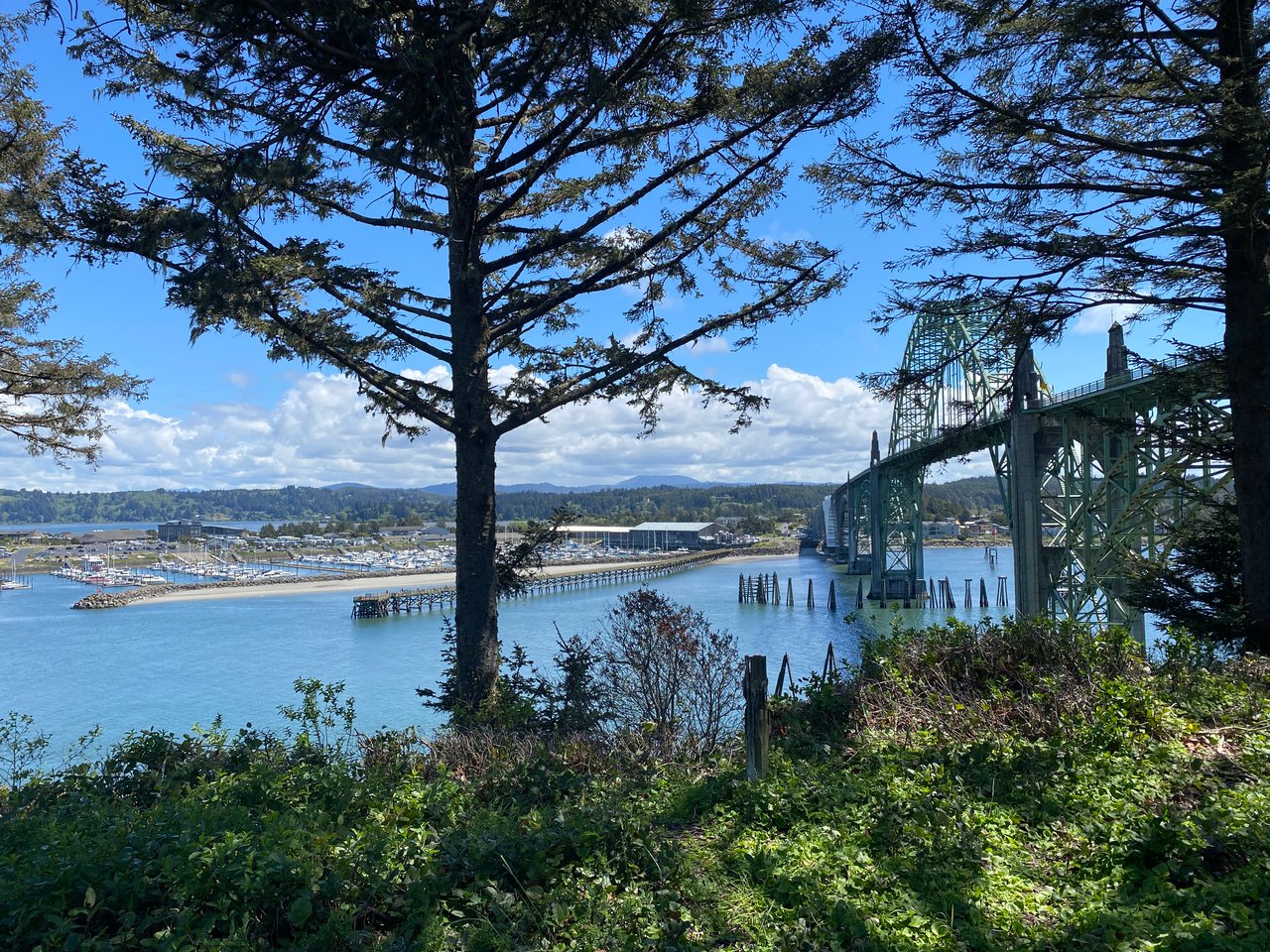
For nineteen years, if you told a friend in Portland you lived in South Beach, the follow-up was always about Rogue. The brewery was the shorthand. It was the smell drifting toward the marina on southerly wind, the sign at the roundabout, the place you sent your visiting brother-in-law when you needed an hour to yourself.
That shorthand is gone. Closed signs appeared Friday, Nov. 14, 2025, on Rogue Brewing's operations in Newport, and eight months later the peninsula's center of gravity has moved. Not to another anchor tenant. To something more diffuse, and, if you live here, more interesting.
The 47,000 square feet nobody in Portland knows about yet
The scale of what emptied out is worth stating plainly. Rogue was drastically behind on rent and taxes, owing $545,000 to the Port of Newport and up to $30,000 in taxes to Lincoln County. The 47,000-square-foot South Beach building is where the company's beers, ales and spirits are produced before they make their way to distributors in all 50 states and more than 50 countries. Ten days after its closure, Rogue's parent company, Oregon Brewing Company filed a voluntary petition for Chapter 7 bankruptcy in federal court, outlining that it had $4.9 million in assets and $16.7 million in liabilities.
The Port toured the buildings in early June. Port of Newport executive director Paula Miranda described the interior as "very piecemeal, which is very much how Rogue did things," stepping around uneven walkways. The metal warehouse where beer was canned is barren, the restaurant is just a room with a kitchen and the large stainless steel brewery vats at the entrance are all auctioned off and gone. The Port has an asset that is estimated to be worth $4-6 million, although it is uncertain exactly how much. Miranda has reached out to Business Oregon, the state's economic development agency, and is in the process of trying to secure a grant for a feasibility study.
What is quietly moving in
Here is what has been confirmed on the record, from the Port's meetings and the Lincoln Chronicle's June walkthrough, arranged by building:
- Main brewery and restaurant building, 47,000 sq ft. Empty. Feasibility study pending. No committed tenant.
- Distillery building, 4,800 sq ft. In October, Port of Newport commissioners approved an amendment to lease a portion of Rogue's 4,800 square foot distillery building to West Coast Seafood. Part of the distillery building is being leased out to a Newport-based fish processor and a marine electronics business, but there are two spaces left that are about 10,000 square feet that the Port doesn't have plans for yet.
- The whiskey barrels themselves. Ninkasi, a brewery based in Eugene, has purchased the barrels of Rogue whiskey that still housed in the company's former distillery building in South Beach.
That reads like a list of small moves, and it is. The point for a resident is that the peninsula's largest single tenant has been replaced by a patchwork of fish processing, marine electronics, and empty square footage waiting for a plan. The Port has scale reasons for wanting that plan to be good. The Port has over $63 million (excluding NOAA) in projects to accomplish; over $18 million are in South Beach, this excludes blacktop replacement and replacement of the Docks and Piers (A-J).
The whale, and how to actually see it
While the Rogue building sat down, the peninsula's other big institution stood up something very large. A 70-foot blue whale skeleton is now on display at Oregon State University's Hatfield Marine Science Center in Newport. People on the coast over the holiday weekend can be among the first to look at it. That was Memorial Day. The bones came from a decade-old salvage effort, and the assembly itself was captured in real time on webcams over about a week in mid-May.
The specifics matter if you are trying to plan a visit that avoids the school-bus crush:
- Where it sits. The skeleton is in the courtyard of the Gladys Valley Marine Studies Building and is a short walk from the Hatfield Marine Science Center's visitor center.
- When you can walk up to it. The ramp at the Gladys Valley Marine Studies Building is open from dawn to dusk daily. That is the outdoor courtyard access.
- Visitor center hours. Business hours at the Hatfield Marine Science Center campus are 8 a.m. to 5 p.m. Monday through Friday except holidays. The visitor center is open 10 a.m. to 5 p.m. daily.
- Why the display is unusual. It's one of just five fully assembled blue whale skeletons on display in the U.S. The event on Thursday, July 16, from 11 a.m. to 4:30 p.m. will include speakers from the Marine Mammal Institute, and a seminar on their research on blue whales. This blue whale skeleton will be one of only a handful of such skeletons available for public viewing in North America, and the only one between Vancouver, British Columbia, and the San Francisco Bay area.
The physical facts are hard to internalize until you are next to them. A three-person crew from Alberta, Canada-based Dinosaur Valley Studios assembled the 5,500-pound skeleton on a steel support frame, installing many of the 180 individual bones one at a time. Then they had to remove about 200 gallons of oil out of the bones. The animal that produced those bones washed up near Gold Beach in 2015 and had spent three years soaking in Yaquina Bay so marine invertebrates could clean them. In other words, the skeleton in the Hatfield courtyard has been part of the estuary system, in a literal sense, longer than most current residents of the peninsula.
The Aquarium's biggest new room in years
A quarter mile down Ferry Slip Road, the Oregon Coast Aquarium opened its largest new exhibit in a long time. Thirteen enclosures, five ecoregions, piranhas, poison dart frogs, an electric eel, hands-on interactives, and original murals by Alexandar Vidal, all included with general admission. Visitors typically spend 30–45 minutes. It's the largest new exhibit OCAq has opened in years. Amazon Basin: An Adventure for the Senses will be at the Aquarium from May 23, 2026 through January 2, 2028.
Two things about this that are useful for residents rather than for tourists. First, the exhibit is temporary and dated, so if you keep meaning to bring your grandkids or a visiting nephew, the window closes January 2, 2028. Second, if you live in Lincoln County, the Aquarium remains one of the best deals on the peninsula: $5 Sundays: every Sunday, Lincoln County residents can visit the Aquarium for just $5. Just bring proof of your Lincoln County residency to qualify. A resident who has not tested that in a while should. The Amazon room, the Jelly Gallery, and Passages of the Deep on a five-dollar Sunday morning is the kind of thing that used to happen in this town before Newport got expensive.
The state park in August, on local time
South Beach State Park has not changed. That is the whole reason to lead with it here, because a lot of things around it have. If you have friends coming down between now and Labor Day, this is what actually matters at the park.
The campground fills. Reservations open 6 months in advance and summer weekends fill quickly, especially yurts. For July-August visits, book as soon as reservations open. Shoulder season (May-June, September-October) offers better availability with fewer crowds and often better weather than summer. If your visitors are flexible, push them to mid-September.
The tent loops close after summer, which is a genuinely useful thing to know if you are the friend who camps rough. We close our tent-only loops (H and I loops) after the summer season, but tents are still welcome at any open RV campsite. If you are hiking or biking into the park, the hiker/biker sites can be used for a discounted rate.
A few less obvious notes for anyone who lives close enough to walk over:
- The paved Jetty Trail stays workable at almost any tide and is one of the flatter bike routes in Newport.
- The disc golf course near the campground is 18 holes and effectively empty on weekday mornings.
- The foghorn. The foghorn audible from camp runs through the night when fog is in. If you are hosting light sleepers, close the west-facing windows and warn them.
- Beaver Creek. Enjoy exploring the freshwater marsh and forested uplands of Beaver Creek Natural Area, 7 miles south of the park. If the state park is packed, Beaver Creek is where locals disappear to.
The through-line
Ten years ago, South Beach's story was a brewery, a state park, and an aquarium, in roughly that order of resident awareness. What has happened in the past nine months is that the brewery came out of the sentence entirely, and the two institutions that remain, plus a new one at Hatfield, are pulling more of the neighborhood's identity than they used to. The peninsula's center of gravity is now the science campus and the marina, not the brewpub roundabout.
For a resident, that changes small things. Where you send visiting family shifts north on Ferry Slip Road, from a restaurant that closed to a courtyard that just opened. Where the Port spends its next dollar shifts, too. And the question of what fills 47,000 square feet a mile from your front door becomes a legitimate variable in what this neighborhood feels like in 2027 and 2028.
If you own a home in South Beach and want a working read on what those variables mean for the value of your property, or if you are watching the peninsula from a distance and wondering whether now is the moment to buy in, that is exactly the conversation we have every week. Audra's Coast Homes tracks the market at the block level, from the marina to the state park boundary. Let's Connect.