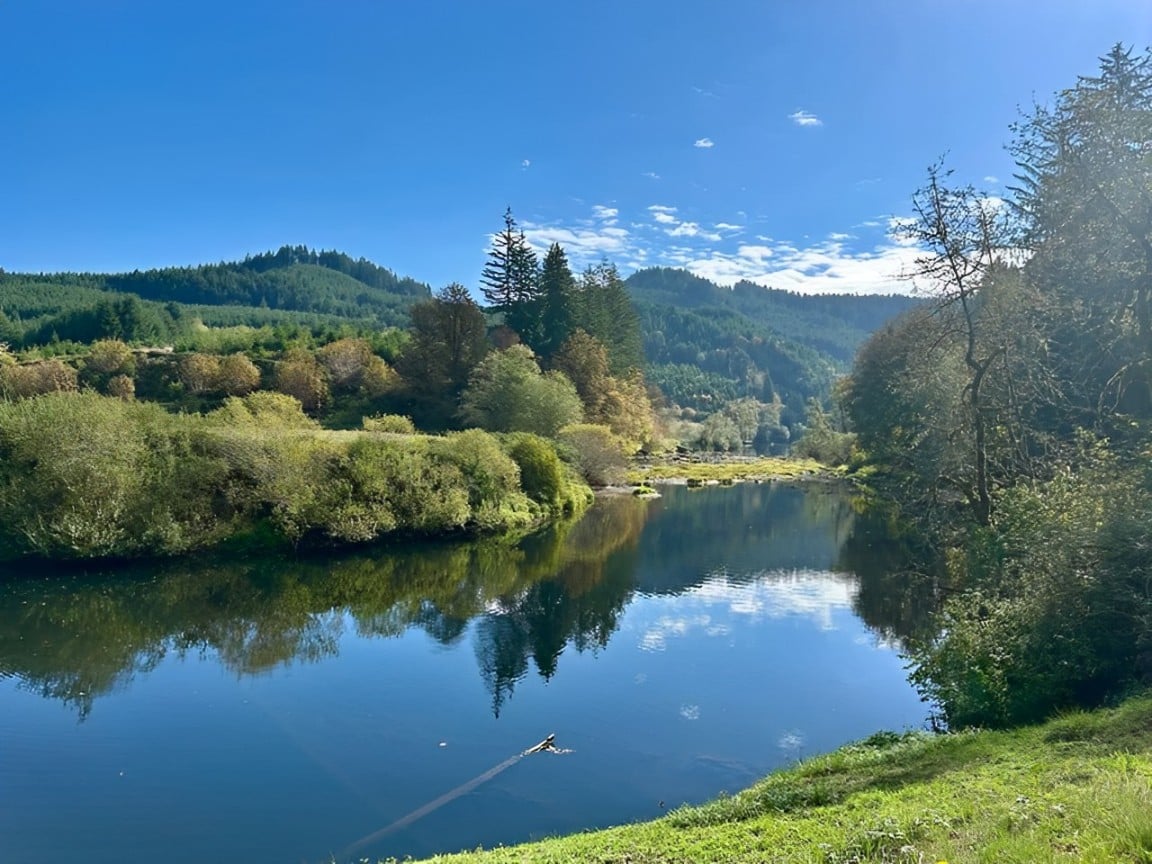
Looking for riverfront or acreage property in Tidewater? It is easy to fall for the setting first. The Alsea River corridor offers a very different feel than the immediate coast, with warmer summer temperatures, a strong connection to outdoor recreation, and the kind of privacy many buyers want. The key is making sure the land can actually support the lifestyle you have in mind. Let’s dive in.
Why Tidewater Feels Different
Tidewater sits east of Waldport along the Alsea River corridor, and that location shapes both the lifestyle and the land. Travel Oregon highlights the area for fishing, hunting, campgrounds, boat ramps, summer water play, and fall and winter drift boating.
The weather also feels different from the immediate coast. NOAA climate normals show Tidewater runs noticeably warmer in summer than Newport, with average maximum temperatures of 70.3°F in June, 74.4°F in July, and 76.0°F in August. By comparison, Newport averages 62.0°F, 64.5°F, and 65.3°F in those same months.
That warmer summer pattern can be a big draw if you want more usable outdoor space, room for gardening, or a property that feels more inland-rural than beach-town cool. At the same time, winter remains very wet, with precipitation normals of 15.54 inches in December, 14.81 inches in January, and 11.34 inches in February. That means land characteristics matter just as much as scenery.
Acreage Does Not Always Mean Flexibility
One of the biggest mistakes buyers make is assuming a large parcel automatically gives them broad freedom to build or improve. In Lincoln County, all land is zoned, and the county specifically advises buyers planning to buy, build, subdivide, or develop property to check with the Planning Division first.
For rural residential land, minimum lot size rules vary by zone. Lincoln County sets minimum sizes of 2 acres per dwelling unit in RR-2, 5 acres in RR-5, and 10 acres in RR-10. That means whether a property works for your plans is often a zoning question as much as an acreage question.
Much of rural Lincoln County is also farm or forest zoned. The county’s residential development guide notes that residential uses in those zones may require conditional-use approval before later permits are issued.
In practical terms, this means you should not buy based on assumptions like these:
- “It has 10 acres, so I can definitely build another dwelling.”
- “There’s plenty of room for a barn or shop, so that should be easy.”
- “It looks level enough, so I can probably place things wherever I want.”
Those assumptions can break down quickly once zoning, setbacks, flood rules, and permit requirements come into play.
What Outbuilding Potential Really Means
Acreage buyers often picture a detached garage, shop, barn, or other accessory structure. In Tidewater, that can be possible, but it should always be treated as a zoning and permit question first.
Lincoln County defines accessory structures as subordinate structures or uses on the same lot. The county also requires building permits for new construction, additions, alterations, and repairs, and its residential checklist includes accessory structures.
That matters because “potential” is not the same as “approved.” If you are buying with a specific use in mind, such as equipment storage, hobby space, or a future detached structure, you will want to confirm what the zone allows and what approvals may be required before you close.
Farm and Forest Rules Can Be Stricter
If a parcel is farm zoned, the rules can be more restrictive than buyers expect. Lincoln County’s farm-dwelling guidance says non-high-value farmland must meet certain acreage or income thresholds, while high-value farmland has its own income-based standard.
The takeaway is simple. A large parcel is not the same thing as a straightforward homesite.
If you are comparing properties in Tidewater, it helps to ask early:
- What is the exact zoning?
- Is a dwelling outright permitted or subject to added review?
- Are there conditions on second dwellings or accessory uses?
- Are there streamside setbacks or flood-hazard standards affecting the build area?
These are the questions that protect you from buying land that looks ideal on paper but does not align with your plans.
Riverfront Views vs. River Access
River adjacency is one of the most appealing parts of Tidewater living, but buyers should be careful not to confuse a scenic setting with legal access. Oregon’s State Marine Board says the public may recreate on state-owned or navigable waterways, and the Department of State Lands says the public may use the beds and banks of Oregon-owned waterways up to the line of ordinary high water.
However, both agencies are clear on an important point: crossing private land to reach the water requires landowner permission. So if a listing shows river frontage or proximity, that does not automatically mean you have deeded access, shoreline rights beyond the legal boundary, or permission to cross adjoining land.
For a riverfront purchase, make sure you verify:
- Deeded access
- Recorded easements
- Property boundary details
- Whether shoreline use matches your expectations
This is one of the most important distinctions between a beautiful river view and a property that truly supports the way you want to use the water.
Recreation Is a Real Lifestyle Perk
The lifestyle value in Tidewater is real. The Alsea River corridor is known for outdoor recreation, and nearby amenities support that appeal.
The U.S. Forest Service lists Mike Bauer Wayside as an accessible fishing site on the Alsea River with year-round access, non-motorized boating, and river and stream fishing. Travel Oregon also points to nearby campgrounds, boat ramps, and drift boating opportunities along the lower Alsea corridor.
For buyers seeking a second home, retirement property, or a quieter full-time move, this access to recreation can be a major part of the draw. Still, public recreation nearby should be treated separately from what your specific parcel legally allows.
Water Rights Are Not Automatic
If a river runs through or along a property, many buyers assume they can use that water for irrigation or other purposes. Oregon Water Resources Department says that is not automatic.
Landowners with water flowing past, through, or under their property do not automatically have the right to use it without authorization. For riverfront acreage, water-right records should be reviewed just as carefully as title, access, and survey details.
This matters most if your vision includes:
- Irrigation
- Agricultural use
- Water diversion
- Any planned use tied directly to the river
A property can be riverfront and still not provide the water-use rights you expected.
Flood Review Should Be Routine
In this part of Lincoln County, flood review is not optional diligence. The county states that extensive areas are subject to periodic flooding and advises buyers along rivers or the shore to check whether a parcel is in a special flood hazard area.
Lincoln County also participates in the National Flood Insurance Program and points buyers to FEMA map resources and the Alsea River gauge for Waldport and Tidewater along Highway 34. For a buyer, that means flood status should be part of the first round of investigation, not something left for late in the process.
Flood-related constraints can influence:
- Where building can occur
- Elevation requirements
- Insurance considerations
- Long-term usability of the land
A scenic low-bank river setting may be appealing, but the floodplain details can have a direct impact on cost and future plans.
Septic Feasibility Comes First
For rural land in Tidewater, septic review is one of the biggest practical checkpoints. Lincoln County’s Planning and Development department oversees on-site sewage disposal, and the onsite division says a site evaluation reviews soil, hydrology, and topography before identifying the approved system area and specifications.
That means a parcel’s build potential is closely tied to whether septic is feasible and where the system can go. If a system would need to cross property lines, the county says an easement is required.
In other words, acreage alone does not guarantee easy septic placement. Before you get too attached to a homesite concept, make sure the land supports the system that would make the home possible.
Wells and Water Systems Need Review Too
Water service deserves its own due diligence. If the property has a domestic well, Oregon Health Authority says the seller must test it during a real estate transaction for arsenic, nitrate, and coliform bacteria and share the results.
OHA also says private well owners are responsible for routine testing and maintenance. If the property is served by a small community water system instead of a municipal utility bill, Lincoln County Environmental Health says those systems are surveyed every 3 to 5 years.
For buyers, the lesson is simple. Do not treat “well water” or “community system” as enough information on its own. You want to understand the source, testing, and any maintenance realities tied to that property.
Driveway Access Can Shape the Whole Property
On rural parcels, access is not just about whether you can physically get in. It can affect how usable the property really is.
Lincoln County Public Works requires an Access Permit for new driveway access or for a change in use of an existing access. On acreage, the road approach, grading, driveway location, and sight distance can all influence how the site functions.
If you are imagining a shop location, parking area, RV setup, or a certain home placement, access design may play a major role in whether that plan works. This is another reason to evaluate the property as a system rather than just a scenic parcel.
Permit Path Matters Before Closing
Lincoln County now starts the building process with zoning-clearance review, and the county requires permits for new construction and additions. For buyers considering future improvements, that timing matters.
If your purchase decision depends on building a shop, adding an outbuilding, placing RV hookups, or making other changes, it is smart to investigate the permit path before closing. It is much easier to make a confident decision when the feasibility work happens up front.
This is where local guidance can make a major difference. The right due diligence helps you separate true opportunity from expensive guesswork.
Wildfire and Power Planning Belong on the List
Acreage living often brings more privacy, but it can also bring more planning responsibility. Lincoln County maintains wildfire-readiness resources and a public-safety power-shutoff page, both of which are relevant for rural buyers.
If you are considering Tidewater acreage, think beyond the home itself. Rural roads, private utilities, storm readiness, and backup power planning all shape your day-to-day comfort and long-term resilience.
A Smart Buyer’s Tidewater Checklist
Before you move forward on a riverfront or acreage property in Tidewater, make sure you have clear answers to these basics:
- Confirm the exact zoning
- Ask what uses and structures the zone allows
- Review flood hazard status
- Verify legal access and any easements
- Check septic feasibility
- Review well testing or water-system details
- Investigate water rights if river use matters to you
- Understand driveway access requirements
- Explore permit and zoning-clearance needs for future improvements
- Consider wildfire readiness and outage planning
When these pieces line up, Tidewater can offer a compelling mix of privacy, recreation, and scenic living. When they do not, even a beautiful parcel can turn into a frustrating fit.
If you want expert guidance as you sort through riverfront and acreage options in Lincoln County, Audra Powell can help you evaluate the details that matter before you commit.
FAQs
What should buyers verify before buying riverfront property in Tidewater?
- Buyers should verify deeded access, easements, legal boundary details, flood hazard status, water rights, septic feasibility, and zoning before moving forward.
How does zoning affect acreage property in Tidewater?
- Zoning affects whether you can build a dwelling, add structures, subdivide, or use the land the way you intend, and Lincoln County advises buyers to confirm allowed uses with the Planning Division.
Can a large parcel in Tidewater automatically support a home or second dwelling?
- No. Lincoln County rules make clear that parcel size alone does not guarantee a home, second dwelling, or accessory use, especially on farm or forest-zoned land.
Do Tidewater riverfront owners automatically have water rights?
- No. Oregon Water Resources Department says water rights are not automatic, even when water flows past, through, or under the property.
Why is septic review important for rural property in Tidewater?
- Septic feasibility is critical because Lincoln County evaluates soil, hydrology, and topography to determine whether an on-site system is approved and where it can be located.
What makes Tidewater different from Newport for acreage buyers?
- Tidewater offers a more inland-rural river corridor setting with warmer summer temperatures than Newport, along with strong access to fishing, boating, and other outdoor recreation.